


Connecting the Dots
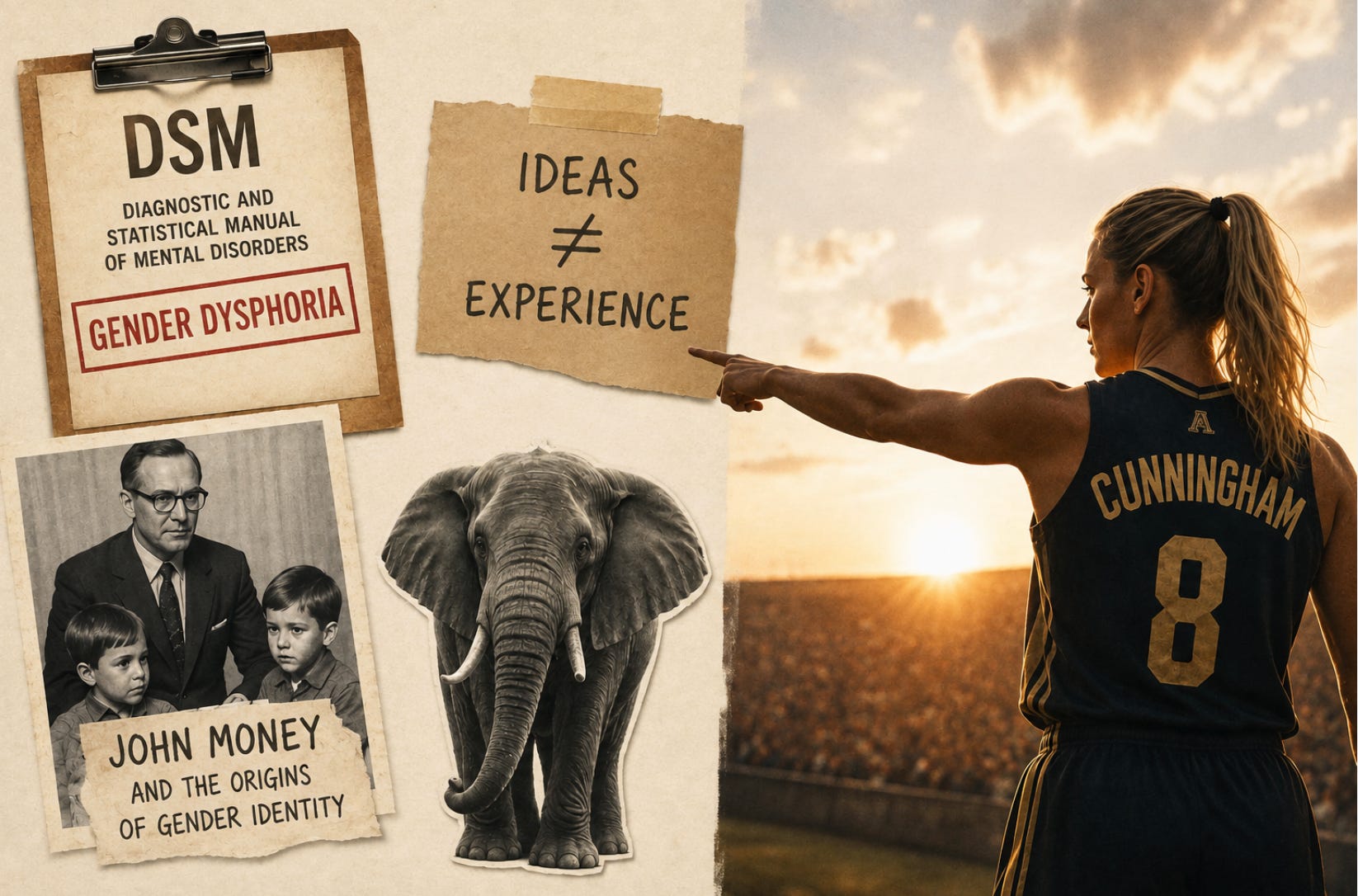
I’ve been thinking since last night about something that sits at the center of much of my work right now: my critique of gender dysphoria, why I believe it functions as a political diagnosis, and how that connects directly to the debate over women’s sports and the activism surrounding Sophie Cunningham. These are not separate conversations. They are different threads woven into the same ideological fabric.
One of the most common refrains from transgender activists is that “trans people have always existed.” I think this statement obscures far more than it reveals.
Throughout history there have certainly been people who cross-dressed. There have been people who wished they were the opposite sex, rejected aspects of their own sex, or struggled with profound discomfort surrounding it. Those experiences are real. What is new is not their existence, but the ideological framework that attempts to gather all of these disparate experiences under a single explanatory model.
I think of “transgender” as what I call a corralling term.
It corrals a wide variety of unrelated experiences—homosexuality, trauma, gender nonconformity, fetishism, body dissatisfaction, autism, obsessive thinking, childhood confusion—and herds them all through a single gate. Once inside that corral, they receive one explanation and one identity. The individual is branded with a label, and that label becomes the organizing principle of their life.
That, to me, is a profoundly political act.
A New Story About the Body
As a young woman I read George Sand and George Eliot—women who adopted male names because women were denied opportunities afforded to men. George Sand sometimes dressed in men’s clothing. Their choices emerged from the realities of their culture, not because they believed they had literally been born in the wrong body.
Likewise, history contains examples of men who cross-dressed for many different reasons, including internalized homophobia or restrictive social expectations.
None of this was understood to mean that these individuals possessed an innate identity that was somehow more real than their bodies.
That narrative is new.
It is the story introduced by the diagnosis of gender dysphoria.
In my view, gender dysphoria rests on a foundational assumption: that every human being possesses an innate gender identity which exists independently of the body and, when the two conflict, the identity should be treated as the more authentic reality.
I reject that premise.
I believe human beings are born whole.
We are embodied creatures before we are conceptual creatures.
Identity is something we construct over time—a story we tell about ourselves. Our bodies, however, are not stories. They are the living foundation of every experience we have.
Before children possess sophisticated abstract reasoning, they experience the world through sensation. They see. They hear. They smell. They balance themselves. They feel hunger, fear, warmth, comfort, tension, movement, emotion.
We are sensing beings before we become narrating beings.
Embodiment is primary.
The Politics of Diagnosis
The Diagnostic and Statistical Manual of Mental Disorders—the DSM—is often spoken about as though it were simply a scientific document. It is not.
Like many institutions, it is influenced by politics, activism, and cultural pressures. Throughout its history diagnoses have been revised, added, removed, and redefined through committee decisions and public lobbying.
Sometimes those changes have been beneficial. I believe removing homosexuality from the DSM was ultimately a positive development.
But recognizing that positive change also requires acknowledging another reality: the DSM is not immune from ideology.
Prior to the diagnosis of gender dysphoria, clinicians more commonly used diagnoses such as transvestism to describe adult males whose cross-dressing was associated with sexual arousal. This was categorized alongside other paraphilias—not because every individual was identical, but because these behaviors often appeared within similar clinical frameworks.
The shift from those earlier concepts to gender dysphoria was not merely a scientific refinement. It reflected changing assumptions about identity itself.
That history matters.
The Origins of Gender Identity
The modern concept of gender identity did not emerge from timeless human wisdom. It has a history.
One of the central figures was John Money, whose infamous experiment involving identical twin boys remains one of the darkest chapters in twentieth-century sexology.
After one twin suffered a catastrophic injury during infancy, Money persuaded the family to raise him as a girl in order to test his theory that gender identity could be socially constructed. The experiment involved deeply unethical practices and ultimately ended in tragedy.
Whether one examines John Money’s work or the later history of gender identity theory, one discovers that these ideas did not arise in isolation. They were shaped by particular academic traditions and particular philosophical assumptions.
That should encourage us to examine those assumptions critically rather than accepting them as settled truth.
Embodiment Versus Ideation
Whatever reason a person may have for rejecting their sex—trauma, internalized homophobia, social pressures, or something else entirely—that reason is separate from actually being the opposite sex.
Rejecting one’s body does not transform one’s embodiment.
We only ever experience our own bodies.
No human being knows what it feels like to inhabit the body of the opposite sex any more than we know what it feels like to inhabit the body of an elephant.
This is why I often use an elephant analogy.
Imagine someone becomes convinced they were meant to be an elephant. They might construct a trunk, attach tusks, enlarge their ears, imitate elephant behaviors, and become utterly convinced this expresses their authentic self.
But every one of those actions would still be built upon fantasy, projection, and objectification.
The individual would necessarily project ideas onto elephants, objectify isolated features of elephants, and then attempt to recreate those features externally.
None of that would provide access to the lived experience of actually being an elephant.
The same distinction applies here.
Ideas about another body are not experiences of another body.
I increasingly think the issue is less accurately described as gender dysphoria than as a combination of sex rejection and trans ideation—a pattern in which a person develops an obsessive explanatory belief that they truly are the opposite sex.
The belief may be sincerely held.
Sincerity, however, does not establish truth.
Why the “Trans Child” Matters
This is why I focus so much attention on gender dysphoria.
Without that diagnosis, the modern concept of the “trans child” becomes much more difficult to sustain.
Historically, cross-sex identification associated with fetishism was largely understood as an adult phenomenon emerging after puberty. Today’s cultural framework introduces children to the possibility that they may possess an invisible identity fundamentally different from their bodies.
Questions like, “Do you feel like a boy or a girl?” do not simply reveal confusion; they can introduce it.
Children rely on adults to help orient them toward reality.
When adults instead present embodiment as optional or uncertain, they may unintentionally encourage confusion rather than resolve it.
This concern lies at the heart of my earlier work on safeguarding children.
Why This Matters for Women’s Sports
This is also why I believe the debate over women’s sports cannot be separated from the debate over gender dysphoria.
If society understands adult males entering women’s spaces primarily through the framework of an innate, authentic female identity trapped inside a male body, people respond with empathy.
If, instead, society understands those same situations through the lens of embodiment—that these are men who, for whatever reason, reject their own sex but that they are still fully embodied men—then the conversation changes.
Women’s sports exist because sex differences matter.
Women’s boundaries exist because embodiment matters.
The philosophical question underneath every policy dispute is remarkably simple:
Do bodies matter?
Everything else follows from the answer.
Staying Grounded in Reality
This is why I insist on careful language.
I say men.
I say women.
I do not feel the need to qualify those words with “biological.”
Women are women.
Men are men.
From there we can describe behavior.
A man may identify differently.
A man may undergo surgery.
A man may take hormones.
A man may sincerely believe himself to be a woman.
But the agent remains a man, while the identity claim, medical intervention, or social performance remains the behavior.
Grounding ourselves in embodiment keeps our language tethered to reality.
Beyond Politics
Ultimately, I do not believe this is merely a political controversy.
It is a moral one.
It is about the relationship between bodies and identities.
It is about whether human beings are fundamentally embodied creatures or whether our ideas about ourselves take precedence over our embodied reality.
These questions extend far beyond transgender ideology. They touch psychology, philosophy, feminism, child development, safeguarding, language, and culture itself. What kind of society do we want to share?
That is why I continue researching across disciplines. I want to understand not just the current debate, but the larger pattern.
Ideas have histories.
Ideologies have assumptions.
And every cultural movement deserves the same careful critique we would apply to any other philosophy.
That is the work I hope to continue.
Bravo! This is such a coherent piece of writing that summarizes so much of what is going on right now.
I have followed your work for a while and I literally agree with you on every single point you make. I think your analysis of the phenomenon of “trans” is spot-on, and I cannot wait to buy your book when it comes out!