


This Was Never Just About the WNBA
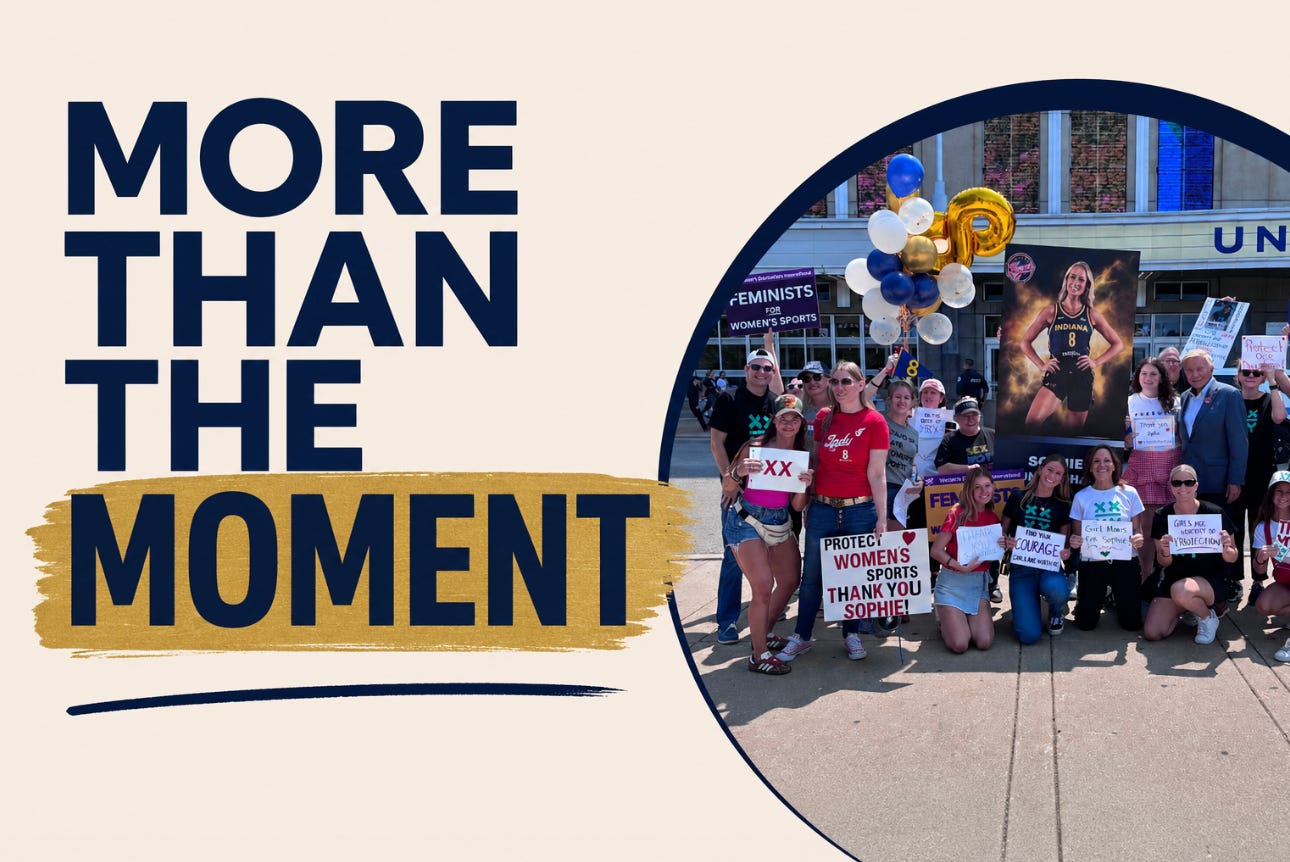
I am absolutely amazed an heartened to see that our Sophie Rally actions in Seattle, Portland, Minneapolis, and Chicago have pushed the WNBA into reviewing its policy regarding “transgender athletes.”
And the immediate response to this has been, “But there aren’t any men playing in the WNBA right now.”
Sure, but this misses the point. The point is that the league has failed to have a clear policy protecting the women’s category on the basis of sex.
Without such a policy, the WNBA is vulnerable. Whether it faces the question next year, or the year after. Right now girls in junior high, high school, and college athletes are playing against boys. These girls, and the boys they are forced to play with, are tomorrow’s professional athletes. If boys are competing in girls’ sports throughout the developmental pipeline, then eventually those same athletes become eligible for women’s professional leagues.
Policies matter most before the conflict arrives.
The Conversation Is Framed Incorrectly
There is something else worth noticing about the way this discussion is being presented.
The WNBA has said it is developing a policy on transgender athletes. But that framing obscures the actual question.
Women’s sports are not organized around identity categories. They are organized around the physical category of sex.
This distinction matters because women who identify as transgender—or as nonbinary—remain female. They have always belonged in the women’s category because they are women. Their identities do not change the sex-based nature of the competition.
A women’s sports category is therefore already inclusive of female athletes with different identity claims.
The question has never been whether people who identify as transgender can participate in sports. The question is whether the women’s category should be single sex or mixed sex.
If we frame the issue accurately, the policy becomes much clearer. Women’s sports exist to provide a protected competitive category for female athletes on the basis of sex.
That is why clarity in language matters.
A Decade of Work
This conversation did not begin with the WNBA.
For years, women across the world have worked to establish sex-based policies in sport. It took years of advocacy before the International Olympic Committee shifted its framework and placed greater responsibility on individual sports to establish eligibility rules appropriate to their competitions.
Change rarely happens overnight.
But sometimes a single public story crystallizes years of work.
Why the Sophie Cunningham Rallies Mattered
Over the past two weeks, something shifted.
The rallies supporting Sophie Cunningham captured the public imagination in a way that few stories have recently. Media outlets began covering the issue. People who had never considered the implications for women’s sports suddenly began paying attention.
As Kara Dansky has often said:
“If we can be heard, we will win.”
Public attention matters because people cannot evaluate arguments they never hear.
So thank you to everyone who attended a rally, shared a video, posted a photograph, talked with friends, or helped bring this conversation into public view. Every person who helped tell this story helped move the conversation forward.
Movements Are Built by Many People
Organizing these events has been exhausting. There has been travel, planning, countless phone calls, and long days.
But as I said in a previous video: movements are never built by one person.
Jean from Women Are Real first sparked the idea of the Sophie rallies. She lit the match and started this wildfire we’re seeing.
Brandi Kruse helped make Seattle unforgettable. And Jennifer Sey brought both her experience as a former elite athlete and her remarkable ability to communicate through powerful imagery: XX/XY. Simple, bold, graphic in green on a black background. I’ve heard Jennifer say, “I wanted something you could see from space.” And her unforgettable image has been the call sign of this shared effort.
Each person has contributed something essential.
That is truly how movements grow.
Why Brands Matter
While most of the feedback I’ve received has been massively positive, I have gotten a small amount of criticism for partnering with Jennifer Sey and XX/XY Athletics.
I might understand this concern if I was partnering with Nike or Coca Cola where a brand partnership would be equated with “selling out.” But to state the more than obvious, this could never happen because every single brand that exists is already captured with the pink and blue flag. There are hundreds of thousands of brands that use pink and blue branding to signal support of trans ideology. The gender critical/sex realist position has had no brands willing to stand up with us until now. We have ONE brand when they have hundreds of thousands, ONE. And that is XX/XY Athletics.
We NEED more brands to stand up with the sex realist position. We live in a corporate consumerist culture and whether we like it or not, our culture is shaped not only by laws and policies but also by symbols, stories, and brands.
Jennifer Sey left an executive marketing career at Levis to build a company that openly supports women’s sports. She has created something that barely exists in today’s marketplace: a recognizable athletic brand centered on women aka adult human females. She is the one brand we have that does not bend the knee to the ideology that tells women we’re not embodied human beings, we’re just an identity label that anyone of any sex can claim.
All this while companies across virtually every industry have publicly embraced progressive gender messaging. Major athletic brands, consumer companies, and countless corporations have invested heavily in those campaigns.
Women deserve brands willing to say something different.
They deserve companies willing to say that supporting women is good business.
They deserve companies willing to celebrate female athletes without apology.
That is why I believe partnerships matter.
Culture follows incentives. If businesses discover that supporting women is something people value, more businesses will eventually do the same.
This Is Bigger Than Basketball
The WNBA policy review matters. But this conversation has never been only about one professional league.
It is about preserving a meaningful women’s category in sport.
It is about privacy in women’s locker rooms.
It is about changing rooms, bathrooms, shelters, spas, prisons, and every place where society has historically recognized sex-based boundaries.
Women’s safety, privacy, and fair competition deserves open public discussion rather than silence.
Keep Building
One lesson from these past weeks has become clear.
No single person creates lasting change.
Some people organize rallies.
Some write articles.
Some speak publicly.
Some create organizations.
Some build businesses.
Some simply have difficult conversations with family members and friends.
Every one of those contributions matters.
So if you have an idea, pursue it.
If you have a strategy, share it.
If you see an opportunity to contribute, take it.
Movements are not built by spectators. They are built by ordinary people who decide to act.
Finally, I want to thank every organization that joined us in Chicago. Women came together from across political and organizational lines—from WDI USA, Democrats for an Informed Approach to Gender, Moms for Liberty, the Young Republicans, TPUSA, and all the independent others who showed with positive support.
That may be one of the most encouraging developments of all.
The protection of women’s sports is increasingly becoming something that brings together women who disagree about many other political issues.
That is how durable movements are built—not through uniformity, but through shared purpose.
Thank you to everyone who has helped carry this story forward. We have made meaningful progress, and I believe the work is only beginning.
Thank you for organizing the Sophie Rally actions! I was there in spirit as I watched from north Florida.
Thanks for the universal 'Keep Building' message about how 'no single person creates lasting change'.