


Every morning over coffee, I find myself asking bigger questions than I planned. Today the question is this:
What is a movement?
People often imagine movements as the story of one charismatic leader standing on a stage, inspiring the masses. But that’s almost never how movements actually begin. They begin with something much quieter—and much more courageous.
There’s an old video I love that illustrates this perfectly.
It starts with one shirtless man dancing alone on a hillside. He looks ridiculous. He isn’t trying to look polished or impressive. He’s simply dancing, completely unconcerned with what everyone else thinks. For a while, he’s just “the lone nut.”
Then something remarkable happens.
One person gets up and joins him.
That first follower changes everything.
The first follower doesn’t simply add another body to the crowd. He transforms the lone dancer into someone worth following. Suddenly there isn’t one strange person dancing—there are two people doing something together. Moments later, a second follower joins. Then another. Before long, the hill is filled with people dancing.
In less than three minutes, a movement is born.
Leadership Is Overrated
The narrator of that video makes an observation that has stayed with me for years:
Leadership is over-glorified.
The shirtless dancing guy gets remembered because he was first. But without the courage of that first follower, nothing happens. Without the second follower, there is no momentum. Without the crowd that comes afterward, there is no movement.
Leadership matters.
But followership matters just as much.
We spend so much time telling people they need to become leaders that we forget movements cannot exist without people willing to publicly support a good idea before it is popular.
The first follower is practicing a form of leadership.
The second follower is practicing a form of leadership.
Even the person who joins after the tipping point plays an important role, because movements eventually require ordinary people deciding that the cause matters more than their fear of standing out.
Different Seasons Require Different Roles
One lesson I’ve learned is that we aren’t always meant to play the same role.
Sometimes we are called to start something.
Sometimes we are called to recognize someone else’s good idea and say, “I’m with you.”
Sometimes we are simply called to strengthen something that already exists.
Every one of those roles matters.
No one can lead without followers.
No movement survives if everyone insists on being the person holding the microphone.
Watching a Movement Form
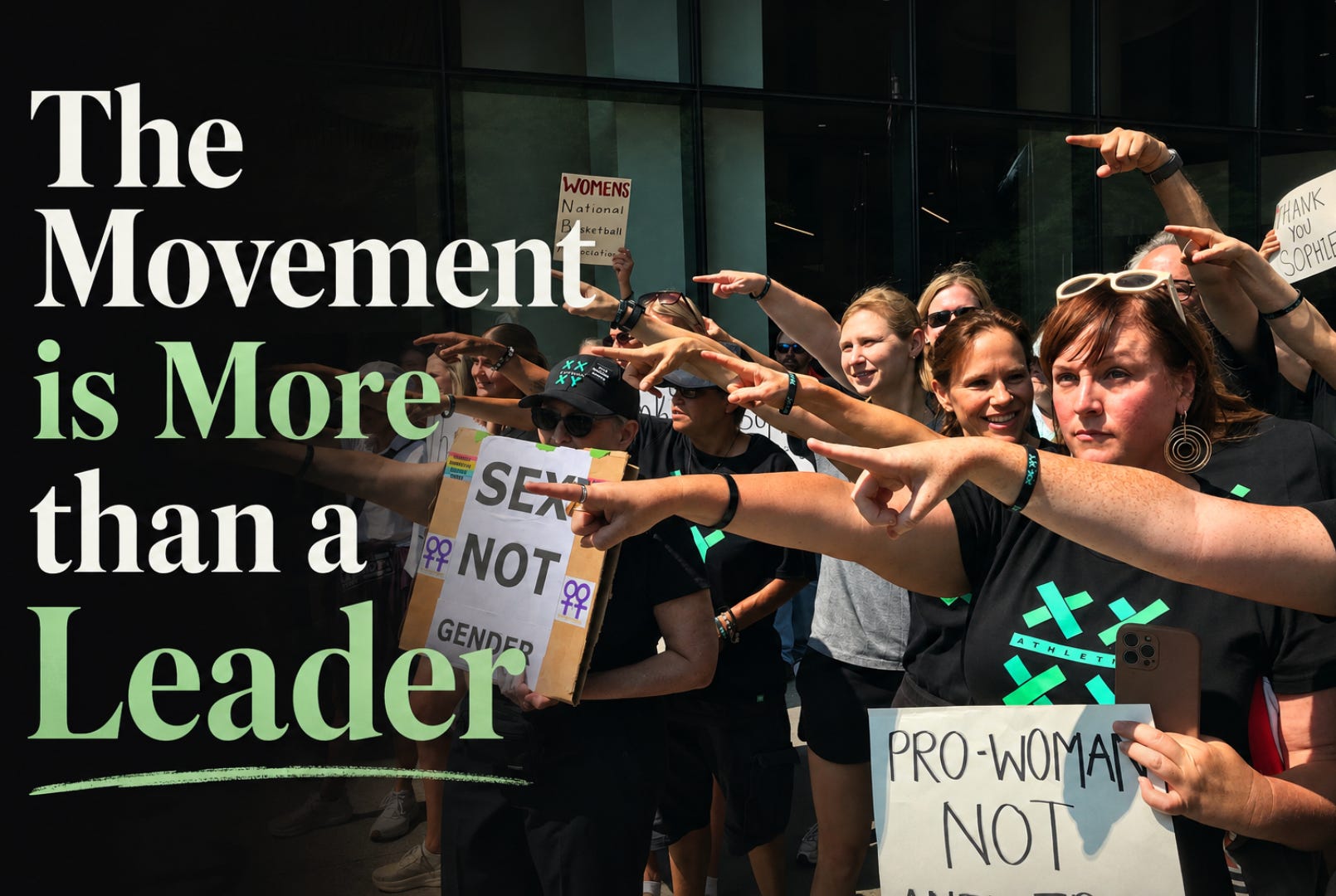
I’ve been thinking about this while watching the Support Sophie Cunningham rallies spread across the country.
It started with Jean from Women Are Reels.
She called me and said she wanted to organize something.
She had the original idea. She took the first risk.
I said yes.
In many ways, I became the first follower. I didn’t invent the idea—I believed in it enough to help it grow instead of remaining a one-time event.
Then Jennifer Sey organized another rally.
Others stepped in.
Now women are organizing events in city after city—Chicago, Indianapolis, New York, Toronto, Dallas, and hopefully Atlanta, with more being planned into September.
That is what a movement looks like.
One event is an event.
Repeated action by different people becomes a movement.
And importantly, the movement becomes bigger than any individual organizer.
Why This Moment Matters
The rallies themselves matter because they are highly visible.
For years, many people have quietly supported fairness in women’s sports. What these rallies do is make that support impossible to ignore.
Movements succeed when they become visible.
People need to see not just one speaker but hundreds of ordinary people willing to stand together publicly.
Visibility changes what feels socially possible.
It gives courage to the next person who has been quietly wondering if anyone else shares their concerns.
I think that’s why this moment has captured so much attention.
People who care about fair competition.
People who believe girls deserve their own sports.
People who have always rooted for the underdog.
Many of them recognize what is happening and want to stand with women and girls.
More Than One Athlete
Recently I talked about Megan Rapinoe’s criticism of Sophie Cunningham and others who have spoken publicly about protecting female sports and single-sex spaces.
From my perspective, what makes this moment significant isn’t simply a disagreement between athletes.
It’s that women who benefited from Title IX are now divided over what Title IX should protect.
One side argues that the law should continue protecting opportunities for women and girls as a sex-based category.
The other argues that gender identity should determine access.
Whatever position someone ultimately takes, this debate is far larger than one athlete or one season.
It’s about the future meaning of women’s sports.
Who Are Your Leaders?
As I recorded my Coffee Talk this morning, I started trying to list everyone who has shown leadership.
Then I stopped.
I realized I was going to leave someone out.
Because movements are full of people whose names never make headlines.
Some lead.
Some organize.
Some donate.
Some show up.
Some encourage.
Some quietly become the first person willing to stand beside someone who looked like the lone nut.
Those people matter every bit as much.
So instead of making my own list, I’d rather ask you.
Who do you see demonstrating leadership?
Who do you see practicing courageous followership?
Who inspired you to step forward?
And perhaps the most important question of all:
What role are you being called to play?
Not everyone needs to lead.
Not everyone needs to follow.
But every movement needs people willing to faithfully do the part that belongs to them.
That’s how movements grow.
One courageous person at a time.
Leaders rise up during times of conflict in history. There's no leader in this movement, per se. That's propaganda. The left uses that tactic to shame the women standing up for their historic civil rights. They can write us off as "right -wing" and "Republican," which most of us aren't. They can drag Riley Gaines through the mud ,or you or Sophie. It's just an opportunity to attack women. There is a huge silent majority in this movement ,and it includes a lot of men. It's a "We The People" movement, and those like you that have stood strong and fierce at the front lines regardless of the attacks and threats are an important component. Being organized and rallying support is what is needed at his point in this war, so thank you Amy for doing that. It's not even about right or left ,or trans vs. women, it's about democracy vs. totalitarianism. Our historic women's rights have been rewritten by progressives to include gender identity. This is a top- down, authoritarian government ruling against the will of the people. We live in a Representative republic. If our policy makers don't support the will of the people, who do they support? (hint; the gender lobbies that put $$$$ in their campaigns).
"I am Spartacus!"