Why the WNBA's "Transgender Policy" Isn't Really About Transgender Athletes
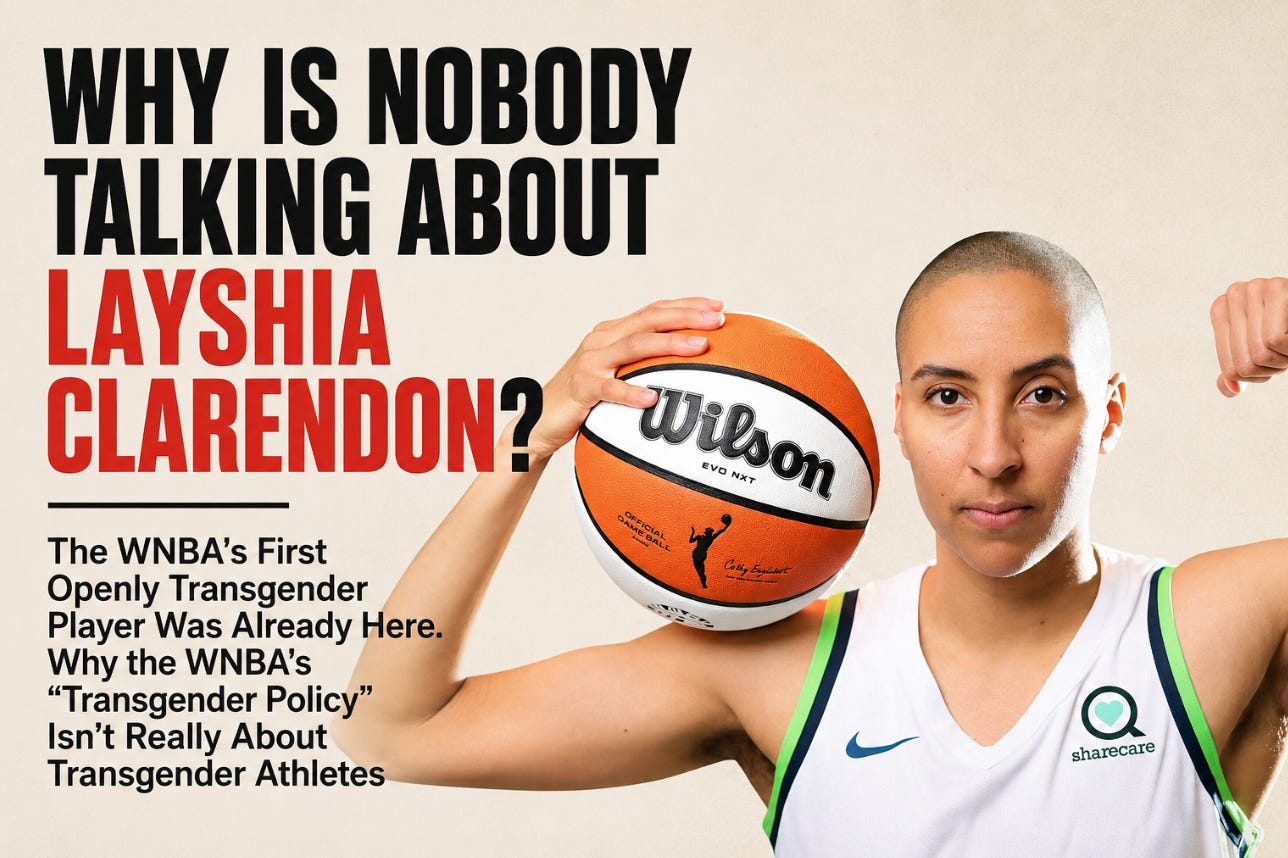
FACT: The WNBA has already recognized and celebrated a transgender-identifying player, Layshia Clarendon.
So when the WNBA announced that it is convening an executive task force to discuss its policy on transgender participation, there is something about that announcement that I think deserves much closer attention.
Commissioner Cathy Engelbert said the league will convene an executive task force to discuss the issue of “transgender participation and gender eligibility.” Bu it seems like she like she is being purposefully disingenuous about the issue at hand. Clarendon was a celebrated athlete and considered a trailblazer. Her identity status was not an issue for anyone.
Layshia Clarendon played in the league from 2013 to 2024. Clarendon publicly identified as transgender and nonbinary, underwent top surgery, used multiple pronouns, and became widely recognized as a trailblazer for transgender visibility in professional sports. I hadn’t remembered this until one of my TikTok followers brought it to my attention.
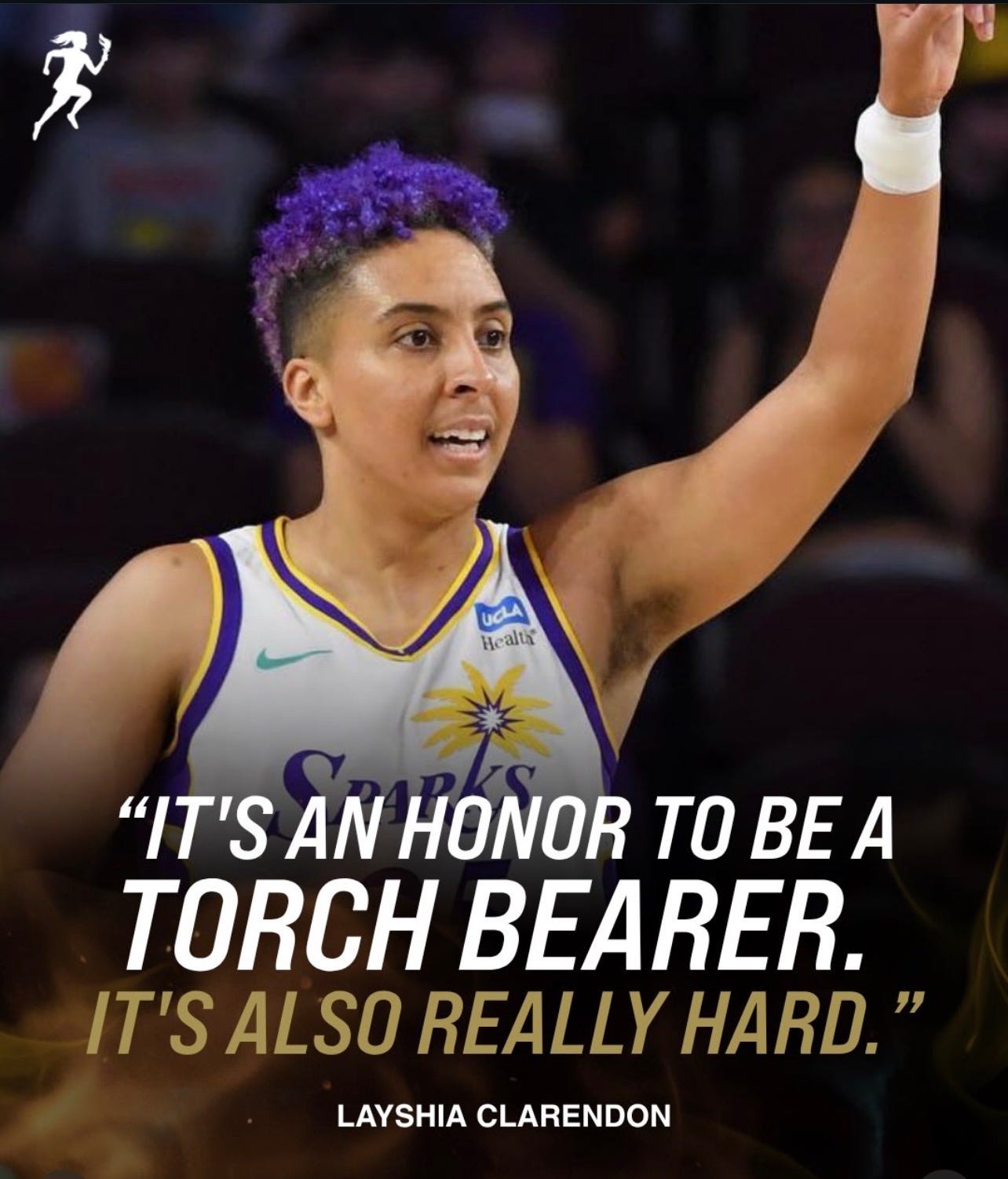
In interviews, Clarendon has spoken candidly about what it meant to be the first.
“I think it’s an honor to be a torchbearer. It’s also really hard... It comes at a cost... hacking through the wilderness and having to blaze a path where there was no path.”
I believe that. Being the first person to publicly challenge cultural expectations is rarely easy, regardless of the issue. It takes courage to step into public scrutiny, and I can appreciate the personal cost that comes with that.
But Clarendon’s story also raises an important question.
If the WNBA has already had an openly transgender player for more than a decade, then what exactly does the league mean when it says it is now discussing a “transgender policy”?
The Question Isn’t About Identity
The issue that women like Sophie Cunningham, Riley Gains, Coach Linda Blade, Jennifer Sey, and many others have been raising has never been about the identities that female athletes claim.
Female athletes who identify as transgender or nonbinary have already participated in the WNBA.
There was never any campaign to exclude them because of those identities.
As I’ve said many times, there will always be transgender-identifying athletes in women’s sports if those athletes are female. A woman may identify as nonbinary. She may identify as a trans man while remaining eligible for the women’s category, depending on the league’s rules regarding hormone use. She may reject the label “woman” altogether. None of those identity claims change the fact that she is female.
Our concern has never been about identity.
Our concern has been about sex.
Women’s sports are a sex-based category, not an identity-based category.
That distinction is fundamental.
A Sex-Based Category
If a female athlete chooses not to use testosterone or other performance-enhancing substances prohibited by league rules, she remains eligible to compete in the women’s category regardless of how she identifies.
The question that has generated public debate is different.
It is whether male athletes should be eligible for the women’s category based on gender identity.
Those are not the same issue.
Yet when the WNBA announces that it is reviewing its “transgender policy,” those two questions are collapsed into one.
That framing creates confusion. This is one of the reasons I repeat ad nauseam: LANGUAGE IS THE BATTLEFIELD. Because language in this debate is being used to manipulate, obscure the real issue, and to create enemies where there are none.
It encourages people to think that anyone questioning eligibility rules must be objecting to transgender identities themselves, when we are actually arguing about the basis on which the women’s category exists: SEX.
The current debate is not about whether female athletes who identify as transgender or nonbinary belong in the WNBA. The league has already answered that question in practice through Clarendon's career. The unresolved policy question is not whether transgender identities are permitted in the league. The unresolved question is how the league will determine eligibility for athletes who are male. Calling this simply a 'transgender policy' obscures the distinction between gender identity and sex-based eligibility.
KnownHeretic’s Substack is a reader-supported publication. To receive new posts and support my work, consider becoming a free or paid subscriber.
Speaking of language "underwent top surgery" -- I'd phrase it as "underwent radical double mastectomy." The euphemisms for these radical surgeries help cement the idea that they are no big deal, when in fact they are a HUGE deal.



Speaking of language "underwent top surgery" -- I'd phrase it as "underwent radical double mastectomy." The euphemisms for these radical surgeries help cement the idea that they are no big deal, when in fact they are a HUGE deal.
So clearly written. “Language is the battlefield” is absolutely right.