


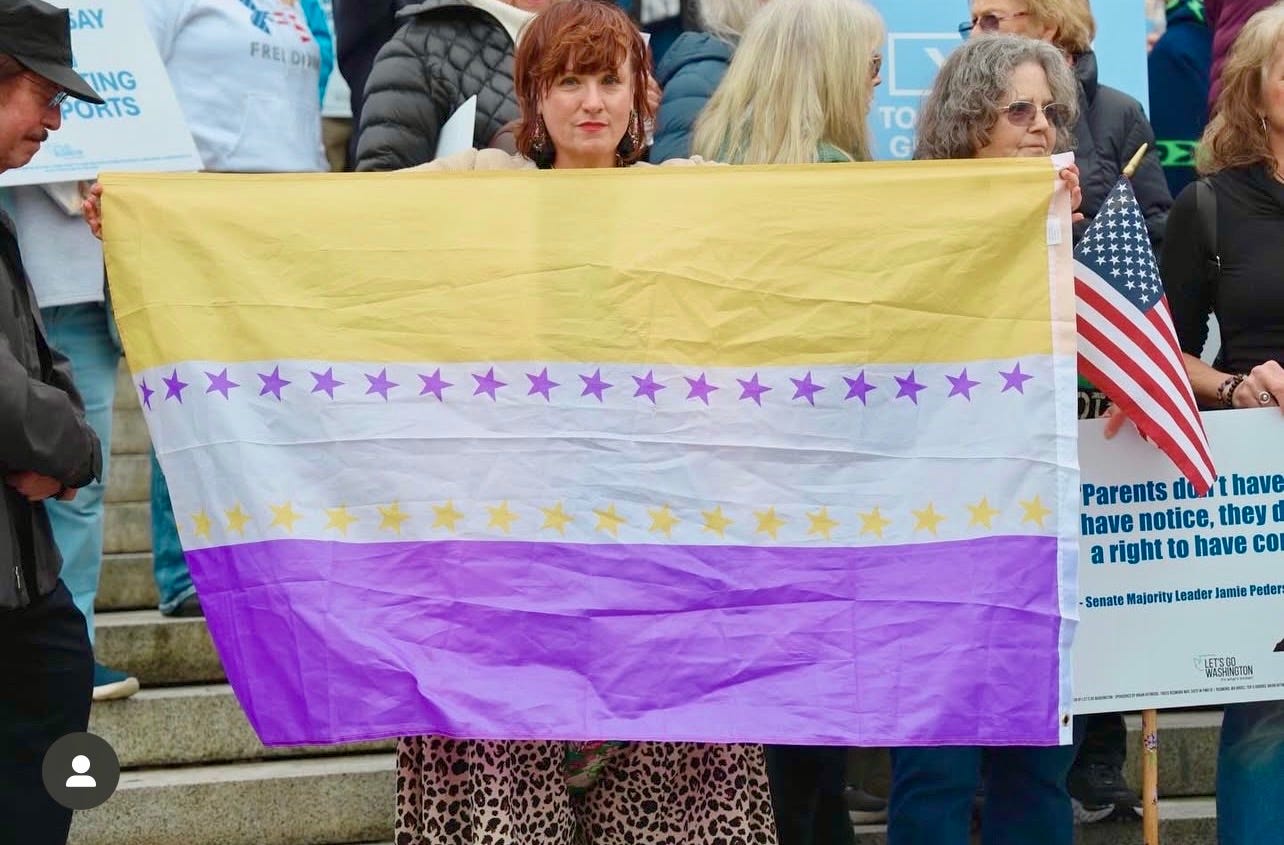
In the above picture, I stand holding the suffragist flag. The 36 stars represent the number of states needed to ratify the 19th Amendment, with a new star sewn on for each state victory until Tennessee ratified it in 1920. Women have had the vote for just over 100 years. The vote for women created the opportunity for women to organize and advocate for ourselves politically on the basis of sex. It gave us a powerful public voice to shape legislative policies that impact women and girls and to secure the future for the girls of future generations. Today’s policies threaten to silence the suffragists’ legacy. I hold the suffragist flag as an urgent reminder: rights secured through struggle can be lost through complacency.
The suffragist flag in the United States emerged as a powerful symbol during the women’s suffrage movement, representing the hard-fought battle for a political voice. The flag’s visual rhetoric reinforced the narrative that suffrage was not a gift but a right earned through perseverance, as Alice Paul emphasized when she unfurled the perfected 36-star version after Tennessee’s ratification in 1920.
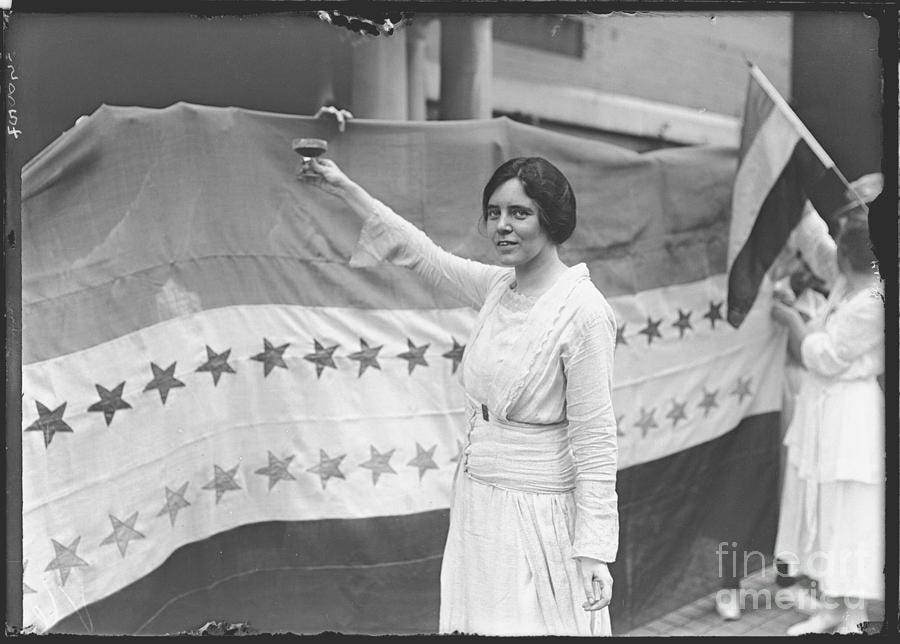
The vote represented more than political participation; it embodied women’s voices in shaping societal norms and laws. Suffragists like Susan B. Anthony framed voting as a tool to challenge systemic injustices, from labor exploitation to marital coercion. Yet this hard-won voice is now being eroded by policies that prioritize gender identity over biological sex, particularly in spaces like sports and locker rooms. The suffragists’ insistence on women’s distinct experiences—rooted in physiological sex based realities such as menstruation and childbirth is now being dismissed in favor of policies that prioritize the gender identity of men and boys over the sex based needs of women and girls.
Gender identity policies that allow men and boys into female-only spaces like sports teams and locker rooms directly undermine women’s political voice. The erosion of sex-segregated spaces also threatens women’s political agency by silencing dissent through institutional coercion. School districts have overridden parental objections and female students’ discomfort, framing resistance as discrimination rather than political advocacy for girls.
If we ignore the metaphysical category of “gender identity” and just look at the physical circumstances of sex, we expose the obvious: When female-specific protections are dismantled under the guise of inclusivity, male dominance is structurally reinforced. Girls’ voices, agency, and consent are all taken away. Girls are not being given a vote in policies that impact their safety, privacy, and protection. While boys with special identity status are empowered to bypass the consent of girls despite their objections.
The ideological enforcement of gender identity over the physical reality of sex has broader implications for women’s political mobilization. By redefining womanhood as a subjective identity rather than a material class, these policies fracture collective action while removing any opportunity for women to politically advocate for ourselves on the basis of sex.
Our foremothers fought long and hard to acquire the vote. If women are redefined as an identity category that men can opt into at will, we lose the ability to be recognized as unique human beings from men. Thus, we lose our voice, our vote, and our right to consent to public policies that directly impact our physical needs and boundaries.
I stand up to reclaim ground already won by my suffragist foremothers. I stand up for myself, my great-grandmothers, my grandmothers, my mother, my sisters, and for all the girls coming after. I stand so you will be en-couraged, filled with courage. I write so you will hear my voice and join me in my stand for women and girls.
Thank you, Amy.
Amy, So clearly and beautifully written! Thank you!