


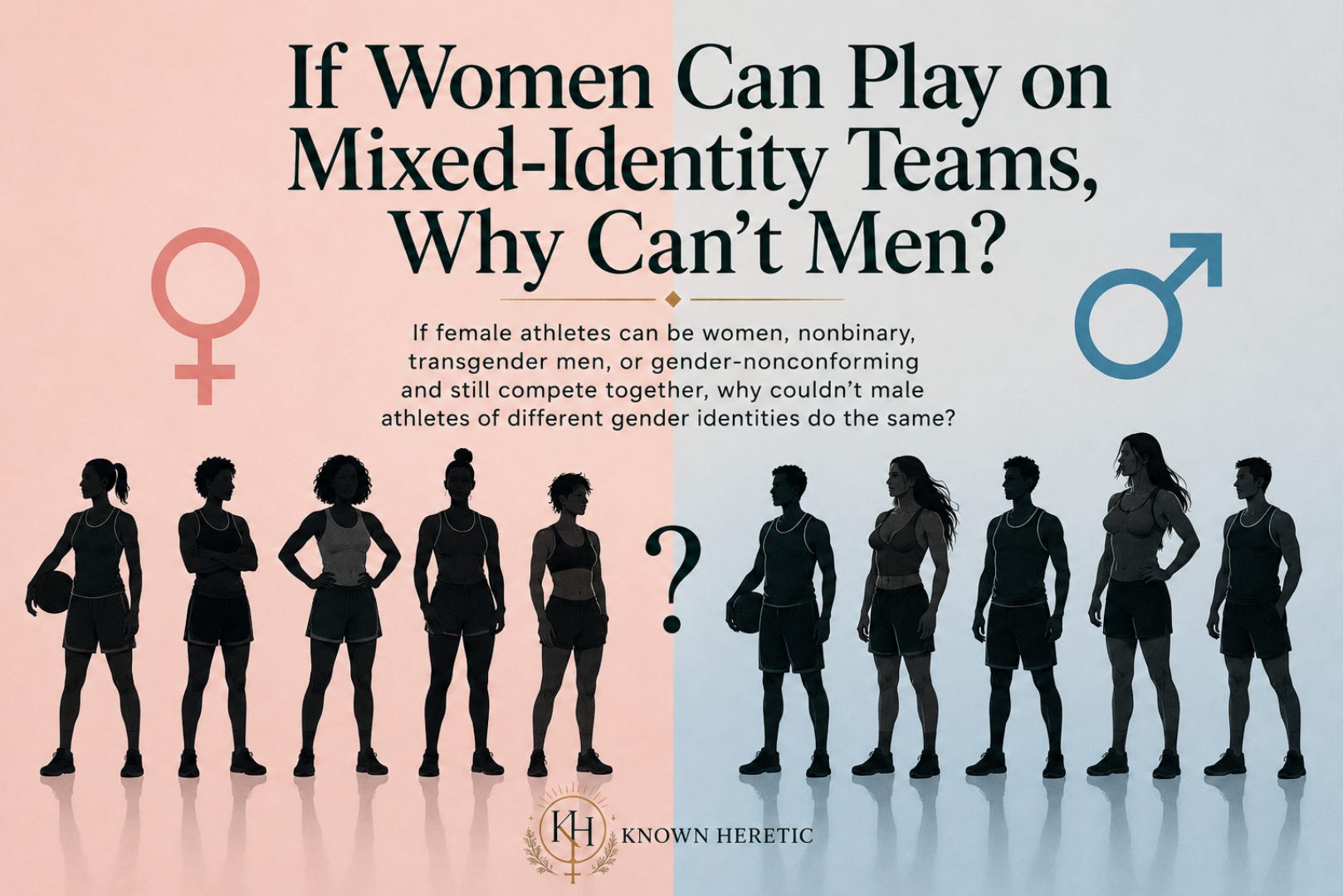
Today I want to talk about something so obvious that you may have missed it:
Women’s and girls’ sports are already mixed-identity sports.
They have been for years.
Female athletes competing in women’s sports do not all share the same gender identity. Some identify as women. Some identify as nonbinary. Some identify as transgender men. Some describe themselves as gender-fluid or gender-nonconforming.
And yet they have competed together.
So I have a very simple question:
If mixed-identity sports are good enough for women and girls, why aren’t they good enough for men and boys?
Women’s Sports Already Include Multiple Gender Identities
Consider just some of the female athletes who have competed in women’s sports while publicly identifying as something other than simply “woman.”
Layshia Clarendon played professional basketball in the WNBA and publicly identified as transgender and nonbinary.
AD Durr, another WNBA player, identifies as nonbinary and uses they/them pronouns.
Quinn identifies as transgender and nonbinary and has played for Canada’s women’s national soccer team, including winning Olympic gold.
Kumi Yokoyama came out as a transgender man after representing Japan in women’s international soccer and playing professionally in the NWSL.
Isaac Ranson, a transgender man, played goalkeeper for Cal State Fullerton women’s soccer and later Minnesota Aurora FC.
Nikki Hiltz identifies as transgender and nonbinary and competes in women’s track and field for Team USA.
Raven Saunders identifies as nonbinary and won an Olympic silver medal in women’s shot put.
Keelin Godsey came out as a transgender man while competing on the Bates College women’s track-and-field team and later competed in women’s hammer throw at the U.S. Olympic Trials.
Elis Lundholm, a transgender man, has competed internationally in women’s freestyle skiing for Sweden.
Hergie Bacyadan, a transgender man, represented the Philippines in women’s boxing at the 2024 Olympics.
Harrison Browne publicly came out as a transgender man while playing professional women’s hockey in the NWHL.
Kye Allums came out as a transgender man while playing NCAA Division I women’s basketball at George Washington University.
Mack Beggs, a transgender boy, competed in girls’ high-school wrestling in Texas—famously while wanting to compete against boys but being required under the rules then in force to compete according to sex.
Alana Smith identifies as nonbinary and competed in women’s skateboarding at the Tokyo Olympics.
And Leo Baker, who identifies as transgender and nonbinary, spent years competing professionally in women’s skateboarding before withdrawing from the Olympic qualification process.
These athletes have different identities.
But they have something relevant to the structure of female sport in common: they are female.
So What Exactly Is the Women’s Category?
This gets us to the question underneath all of this.
What is a women’s sports category actually categorizing?
Is it an identity category?
Or is it a sex category?
Because those are not the same thing.
If “women’s sports” literally means sports for everyone whose gender identity is woman, then a transgender man should seemingly cease belonging to the category upon identifying as a man. A nonbinary athlete shouldn’t belong to a category supposedly defined by the identity “woman” either.
And yet female nonbinary athletes and transgender men have competed in women’s sports.
That tells us something important.
The women’s category (for some reason) does not require a single gender identity (unlike the men’s.)
Women’s sports include females with diverse identities. But women’s sports ALSO INCLUDE males with diverse identities. Thus, as it currently stands, the female sports category is NEITHER a sex-designated category (since it includes males) NOR is it an identity-designated category (because it includes females of diverse identities).
So what is female sports? Currently, it is a DOUBLE STANDARD DUMPING GROUND for anyone of any identity. Women’s sports are both mixed-sex and mixed-identity. While men’s sports remain single-sex and single-identity. How is this fair???
Why Can’t Men’s Sports Be Identity-Diverse Too?
Imagine applying precisely the same principle to male athletes.
A male athlete identifies as a man? Welcome to the male category.
A male athlete identifies as nonbinary? Welcome to the male category.
A male athlete identifies as gender-fluid? Welcome to the male category.
A male athlete identifies as a transgender woman? Welcome to the male category.
Why can’t male athletes participate in the male category while having diverse identities just as female sports already does???
Men and boys can have diverse identities and be INCLUDED on male teams. Nobody has to tell a feminine boy that he must become masculine. Nobody has to tell a nonbinary male that he must identify as a man. And nobody has to tell a transgender-identifying male what clothes to wear, what name to use, what personality to have, or how to understand himself.
The sporting category simply isn’t being determined by those things.
And this is what is ALREADY HAPPENING in female sports. So I repeat, if this is good enough for the girls, why isn’t it good enough for the boys?
So why shouldn’t males receive the same identity diversity?
Sex Determines the Category. Identity Belongs to the Athlete.
I think we have become accustomed to treating two completely different questions as though they were one:
Who are you?
and
Which sporting category are you eligible to compete in?
But they don’t have to have the same answer. The first question concerns identity. The second question concerns the organizing principle of competitive sport.
Seperating those questions offers a remarkably simple solution:
Sex determines the sporting category. Identity belongs to the athlete.
Under that principle, transgender and nonbinary people aren’t excluded from sports. They play sports. They compete. They join teams. They pursue championships. They form friendships. They get coaching. They experience everything that participation in sport provides. But participation does not require moving from one sex category into the other.
There Is Another Advantage to This
It eliminates the need for sporting organizations to become gender-identity investigators. Think about the strange questions an identity-based system eventually creates. How do we know someone is really nonbinary? How long must someone identify as transgender? What makes an identity sufficiently sincere? Does clothing matter? Pronouns? Legal documents? Hormones? Surgery?
None of these questions is necessary if gender identity simply isn’t the criterion determining the competitive category.
A male athlete can have any identity available to any other male athlete.
A female athlete can have any identity available to any other female athlete.
The category of sex designated sports remains stable while the people inside it remain psychologically, socially, and culturally diverse.
That seems considerably more inclusive to me than requiring a sporting organization to determine which identities qualify someone to cross a sex boundary.
And This Is Where the Double Standard Becomes Interesting
Women and girls have already demonstrated that a sex category can accommodate enormous identity diversity. A female athlete can identify as a woman. Or nonbinary. Or a transgender man. Or gender-nonconforming. Female athletes do not need to share a gender identity in order to compete with one another. This has already been demonstrated for over a decade!!!
So why are we behaving as though male athletes cannot tolerate the same arrangement???
Why couldn’t men’s and boys’ sports include masculine men, feminine men, transgender-identifying males, nonbinary males, gender-fluid males and males who don’t care about gender identity at all?
Why must identity diversity be solved by changing the boundaries ONLY of the female category?
That’s the part I want people to sit with.
Because if we really believe identity is expansive—if we really believe people should be free from restrictive gender stereotypes—then surely the male category should be expansive enough to contain every kind of male human being.
You don’t have to be masculine to compete with males.
You don’t have to identify as a man to compete with males.
You don’t have to conform to anybody’s expectations about what a boy or man is supposed to look like, wear, enjoy, believe or call himself.
You can simply be yourself.
Riddle Me This
For more than a decade, female sports have included athletes who describe themselves using dramatically different gender identities.
Women.
Transgender men.
Nonbinary people.
Gender-nonconforming people.
They have competed alongside one another.
So tell me again:
Why do male athletes need access to the female category in order for sport to accommodate their identities?
Why can’t boys’ teams contain boys with many identities?
Why can’t men’s teams contain men, nonbinary males, transgender-identifying males and gender-nonconforming males?
Why is identity diversity treated as perfectly compatible with the female sporting category, but somehow impossible to accommodate within the male one?
If mixed-identity sports are good enough for the girls—
why aren’t they good enough for the boys?
Why can’t they? Because it isn’t “affirming” and doesn’t feed their fetish, and because they know they won’t automatically be the winners.
This is brilliant! Since many states have turned formerly female sports into an open category, while the legal battle continues over allowing mediocre males to make the girls who want to play sports act as extras in their fantasy, maybe leave the old teams to the troons (and any girls who feel sad for them), and create an entirely new category of "biology based sports," or BBS. No need to hold everyone hostage over language manipulation. They've thrown tantrums and refused the creation of a mixed-sex category for them, so leave them to squat in the "girls" sports, no swab test required and all "women and girls" welcome. Meanwhile, BBS (notice no inclusion of the word girl or woman) is signing up females and a swab is required.